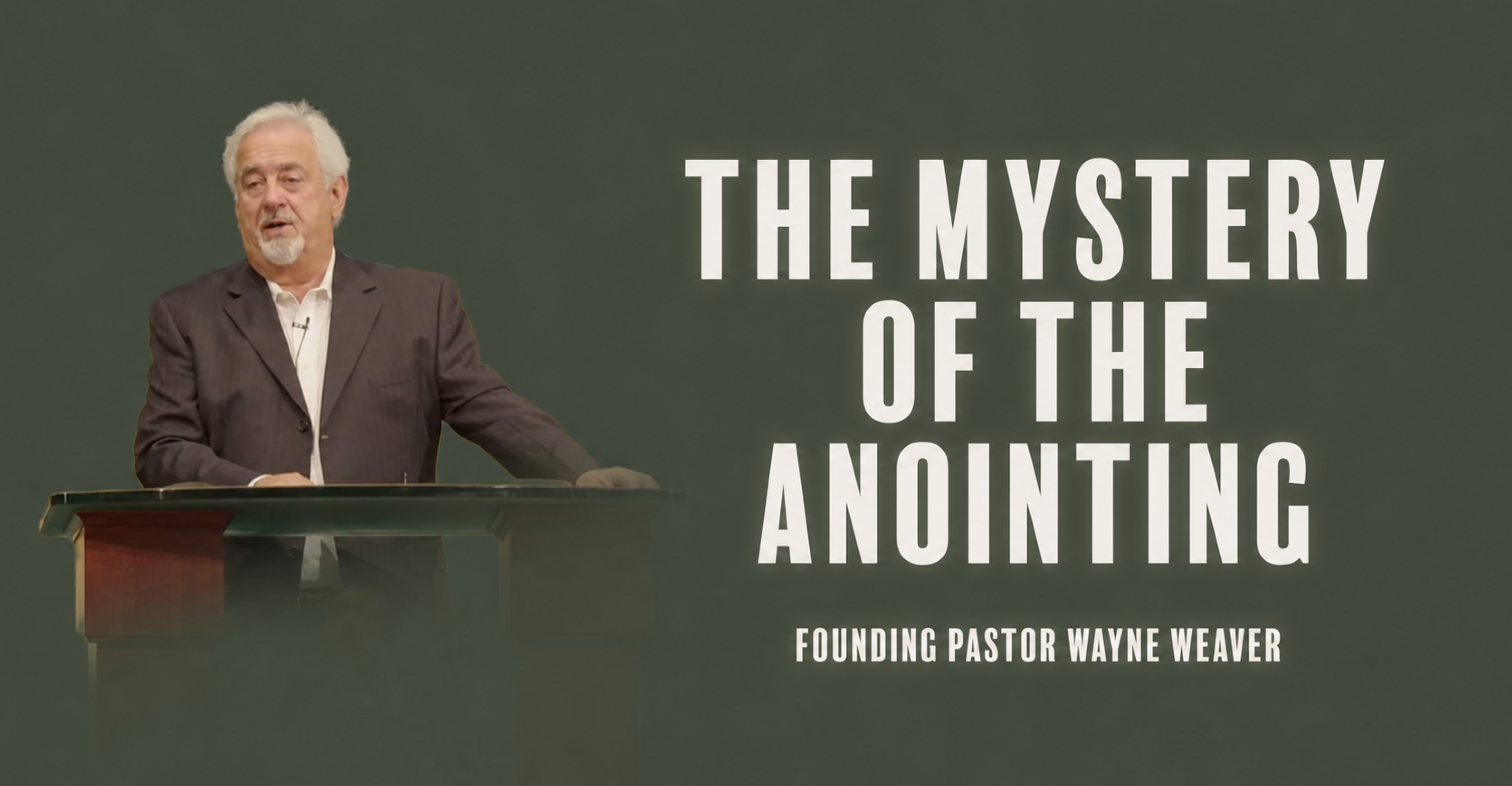
The Mystery of Anointing:
What It Is, What It Does, and Why You Need It
From Sunday morning message, titled, The Mystery of The Anointing, by Founding Pastor Wayne Weaver, delivered July 26, 2026.
Watch on YouTube.
Hear audio podcast on PodBean.
Anointing is one of those words that gets used often in Christian circles, yet few people can clearly explain what it actually means. Is it a feeling? A sound? A style of preaching? Understanding the true nature of anointing can change the way you walk through life, face hardship, and relate to others.
What Does "Anointing" Actually Mean?
The word "anointed" in the Bible simply means to smear. When oil is applied to something, it penetrates deeply. You cannot simply wipe it away with a cloth. It stays. That sticking quality is at the heart of what anointing is.
Anointing is symbolic of the Holy Spirit. Oil in Scripture is consistently used as a picture of the Holy Spirit at work. Just as oil keeps an engine running smoothly for hundreds of thousands of miles, a life filled with the Holy Spirit can go far without wearing out.
The Holy Spirit is not a minor character in the believer's life. He is the director, the comforter, and the guide. Without His presence, we are left navigating life on our own, making our own turns, and hoping we end up in the right place.
Is Anointing the Same as Good Preaching or Good Singing?
No, and this distinction matters. A song can be beautifully performed without being anointed. A message can be well-articulated and emotionally moving without carrying the anointing of God. These things should not be confused.
A message that is not anointed by God is simply information. And information alone does not change lives. What people who are hungry and thirsty need is not more content. They need something that reaches into the deep places of their hearts and brings transformation.
What Does Anointing Do? Lessons from the Tabernacle
In Leviticus 8, Moses anointed the tabernacle, its furniture, its altar, and Aaron the priest with oil. Before the anointing, the tabernacle was just a structure. After the anointing, it became a place set apart for God's presence and purpose.
The same principle applies to people. When a person is anointed by God, they become a vessel set apart for His use. God gains a new avenue into that life, and through that life, He can reach others.
Why Did God Choose David? What Anointing Looks Like in a Person
"But the Lord said unto Samuel, Look not on his countenance or on the height of His stature; because I have refused Him: for the Lord seeth not as man seeth; for man looketh on the outward appearance, but the Lord looketh on the heart." 1 Samuel 16:7 KJV
David was not the obvious choice. He was young, overlooked by his own family, and not even invited to the ceremony where a king would be selected. He was out in the mountains tending sheep, one of the lowest occupations of the day.
But God saw something in David that no one else could see. In those lonely nights on the hillside, facing lions and bears without backup, David was developing a relationship with God that would define His entire life. God was not looking for perfection. He was looking for a heart He could speak to.
David was anointed multiple times throughout his life, by Samuel, by the men of Judah, and by the elders of Israel. Each anointing marked a new level of authority and purpose. And even in his grief, David anointed himself with oil before entering the presence of God, not to perform a ritual, but to shake off sorrow and come before God with a clear heart.
Where Does Anointing Come From? The Answer Might Surprise You
"Thou preparest a table before me in the presence of mine enemies: thou anointest my head with oil; my cup runneth over." Psalm 23:5
This is one of the most important truths about anointing. It does not come when everything is going well. It comes in the presence of enemies. It comes in the middle of difficulty, opposition, and hardship.
God does not set the table in a comfortable, conflict-free room. He sets it right in front of whatever is trying to destroy you. And it is there, in that very place, that He anoints your head with oil.
When the anointing comes that way, it changes everything:
• It changes how you see (your eyes are different)
• It changes how you hear (your ears are different)
• It changes how you speak (your mouth is different)
• It changes how you think (your mind is different)
This is why running from hard things robs you of something precious. The anointing that comes through difficulty is not available any other way.
What Happened When a Woman Anointed Jesus?
In Mark 14, a woman came to Jesus with an alabaster box of spikenard, an extremely rare and expensive oil imported from the Himalayan mountains. Its value was equivalent to an entire year's wages. She poured it over Jesus and was immediately criticized for the waste.
Jesus silenced the critics: "She hath done what she could: she is come aforehand to anoint my body to the burying." Mark 14:8 KJV
And then He said something remarkable: "Verily I say unto you, Wheresoever this gospel shall be preached throughout the whole world, this also that she hath done shall be spoken of for a memorial of her." Mark 14:9 KJV
That anointing did not stay in one moment. It traveled with Jesus through every painful step that followed. In the garden of Gethsemane, in Pilate's hall, on the road to the cross, in the tomb, the fragrance of that spikenard remained. What she poured out in love and sacrifice became a source of strength that carried Him through His darkest hours.
This is what anointing does. It leaves an imprint. It stays. It travels with a person into places you will never see.
How Does Anointing Work in Everyday Life?
Anointing is not reserved for preachers or worship leaders. There is anointing for singing, for playing an instrument, for being a mother in the home, for being a Father in the community, for being a young person among peers.
And the anointing you carry is meant to be given away. The difficulties you have walked through, the pain you have survived, the grief you have surrendered to God, all of it has the potential to become oil that you pour into someone else's life.
Sometimes it is a word spoken at exactly the right moment. Sometimes it is a hand on a shoulder. Sometimes it is simply saying, "God is with you." These are not small things. These are the ways anointing moves from one life to another.
"Is any sick among you? let him call for the elders of the church; and let them pray over him, anointing him with oil in the name of the Lord: And the prayer of faith shall save the sick, and the Lord shall raise him up; and if He have committed sins, they shall be forgiven Him." James 5:14-15 KJV
What Happens When We Don't Embrace the Hard Things?
People who run from opposition, criticism, or pain miss the table God has set for them. The anointing that comes through hardship cannot be manufactured in comfort. It is forged in the fire of real life.
Bitterness is always an option when life is hard. But bitterness produces nothing that can help anyone. Oil, the kind that comes from surrendered suffering, is pure. It does not carry the fungus of criticism or complaint. It carries life.
The church functions when people pour out what they have received. Not complaints. Not criticism. But love, acceptance, encouragement, and the kind of presence that says, "I see you, and God has not forgotten you."
The Spirit of the Lord and the Purpose of Anointing
"The Spirit of the Lord is upon me, because he hath anointed me to preach the gospel to the poor; He hath sent me to heal the brokenhearted, to preach deliverance to the captives, and recovering of sight to the blind, to set at liberty them that are bruised." Luke 4:18 KJV
Jesus was specifically anointed for specific purposes. And that same Spirit, working through people who have been touched by God, can accomplish those same things today through ordinary lives made extraordinary by the oil of the Holy Spirit.
Life Application
This week, look for one person in your life who is sitting in the middle of a hard season. It might be a coworker, a family member, or someone in your church. Do not wait until you have the perfect words or the right moment. Bring what you have. A kind word, a text, a hand on a shoulder, a genuine "I am praying for you." That is anointing in action. The oil you have received through your own trials is meant to be poured out, not stored away.
Ask yourself these questions as you go into the week:
1. Am I running from a hard situation that God may actually be using to anoint me?
2. Have I allowed past pain to become bitterness, or have I let it become oil I can give to others?
3. Who in my life right now needs me to pour something into them, and what is stopping me?
4. Do I truly believe that God is not ashamed of me, even in my most difficult seasons?
The anointing of God is not reserved for the polished or the prominent. It is for the shepherd boy on the hillside, the woman with the expensive oil, and the person sitting in the pew wondering if any of this applies to them. It does. The table is set. The oil is ready. Do not avoid the very place where God wants to meet you.
7/28/2026