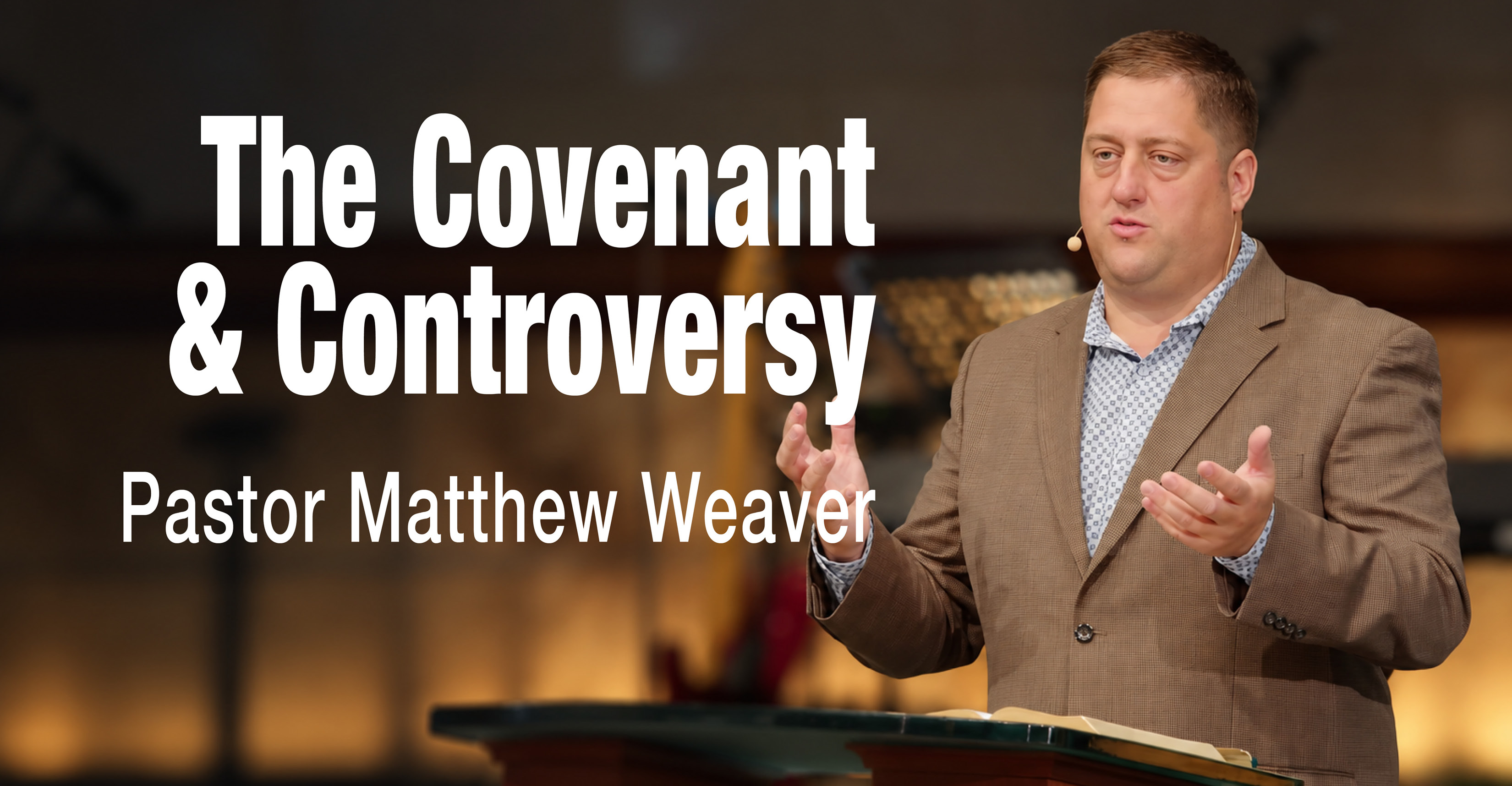
Covenant Controversy: What Does God's Promise to Abraham Really Mean?
From Sunday morning message, titled, The Covenant and Controversy, by Pastor Matthew Weaver, delivered September 20, 2026.
Watch on YouTube.
Hear audio podcast on PodBean.
Few topics in Scripture have sparked more debate, division, and even bloodshed throughout history than God's covenant with Abraham. Understanding what that covenant actually says, who it applies to, and how it connects to the world today is not just an academic exercise. It matters deeply for anyone who wants to know what God is doing in the world right now.
What Is a Covenant, and Why Does It Matter?
A covenant is simply a binding agreement. In Hebrew, the word is brit, which literally means "a cutting." When God made His covenant with Abraham, He performed what is called a self-maledictory oath ceremony. In plain terms, God walked between the pieces of the sacrificed animals and placed the consequence of breaking the covenant entirely upon Himself.
This is remarkable. God did not ask Abraham to share the burden of the oath. He took it all. That means the covenant's fulfillment rests on God's faithfulness, not Abraham's or anyone else's.
What Did God Actually Promise Abraham?
The covenant is spelled out clearly in Genesis 17. God said:
"Behold, my covenant is with you, and you shall be the Father of a multitude of nations... And I will establish my covenant between you and your offspring after you, throughout their generations, for an everlasting covenant, to be God to you and to your offspring after you. And I will give to you and to your offspring after you the land of your sojournings, all the land of Canaan, for an everlasting possession." Genesis 17:4-8
Several things stand out here. First, God calls it His covenant, not Abraham's. Second, it is described as everlasting. Third, it is specifically tied to Abraham's physical offspring. Fourth, it includes a specific land promise covering the territory of Canaan.
In Genesis 22, after Abraham demonstrated his willingness to offer Isaac, God expanded the blessing:
"By myself I have sworn, declares the Lord, because you have done this and have not withheld your son, your only son, I will surely bless you, and I will surely multiply your offspring as the stars of heaven and as the sand that is on the seashore. And your offspring shall possess the gates of his enemies. And in your offspring shall all the nations of the earth be blessed, because you have obeyed my voice." Genesis 22:16-18
Was the Covenant With Ishmael or Isaac?
This is one of the central points of conflict in the world today. Islam teaches that the covenant passed through Ishmael. The Bible is clear that it did not. God confirmed the same covenant with Isaac, and then again with Jacob. The Psalms affirm this generations later:
"He remembers his covenant forever, the word that he commanded, for a thousand generations, the covenant that he made with Abraham, his sworn promise to Isaac, which he confirmed to Jacob as a statute, to Israel as an everlasting covenant, saying, 'To you I will give the land of Canaan as your portion for an inheritance.'" Psalm 105:8-11
The line is clear: Abraham, Isaac, Jacob, Israel. Not Ishmael.
Why Is There So Much Conflict Over This Land?
The land described in Genesis 15 stretches from the river of Egypt to the Euphrates. It is a relatively small piece of territory, yet it has been the center of more conflict throughout human history than perhaps any other place on earth. Wars, crusades, genocides, and modern military conflicts have all swirled around this region.
The reason goes deeper than politics or ethnicity. There is a spiritual dimension to this conflict. The unseen realm has a stake in who holds title to this land. Understanding that helps explain why the nations are so fixated on what happens there, even when far larger conflicts go largely ignored.
What Do the Later Covenants Add to This Picture?
God's covenant relationship with His people did not stop with Abraham. It continued and deepened through several key moments in Scripture.
The Sinai Covenant
At Sinai, God called Israel to be His treasured possession, a kingdom of priests and a holy nation. He gave them His words, the Ten Commandments, as the foundation of their covenant relationship with Him.
The Davidic Covenant
God promised David an eternal throne. Through 2 Samuel 7, He declared that David's house and kingdom would be established forever. This promise ultimately points to Jesus, who is the royal heir of David's line. The angel Gabriel confirmed this to Mary:
"He will be great and will be called the Son of the Most High. And the Lord God will give to Him the throne of his Father David, and He will reign over the house of Jacob forever, and of His kingdom there will be no end." Luke 1:32-33
The New Covenant
Through the prophet Jeremiah, God spoke of a coming new covenant that would be different from the one made at Sinai. Crucially, Jeremiah specifies who this covenant is with and when it will be fully realized:
"A time is coming, says the Lord, when I will make a new covenant with the people of Israel and Judah... But I will make a new covenant with the whole nation of Israel after I plant them back in their land, says the Lord. I will put my law within them, write it on their hearts and minds, and I will be their God and they will be my people." Jeremiah 31:31-33
Notice the sequence. The planting back in the land comes first. Then the full realization of the new covenant follows. This is not yet fully accomplished.
What Does Paul Say About Israel in the New Testament?
Romans 11 is one of the most important and often overlooked passages on this subject. Paul writes:
"I do not want you, brothers and sisters, to be ignorant of this mystery, lest you be wise in your own eyes: a partial hardening has come upon Israel, until the fullness of the Gentiles has come in. And in this way all Israel will be saved." Romans 11:25-26
Paul's view is not that Israel has been permanently rejected. He believed in a partial, temporary hardening, not a final rejection. He also affirmed that the gifts and calling of God are irrevocable. God does not take back what He promised to Abraham's descendants.
Paul also makes clear that Gentile inclusion into salvation is itself a miracle that came about because of Israel's stumbling. Rather than replacing Israel, Gentile believers owe a debt of gratitude for the access they now have.
How Did the Church Get Confused About This?
The early followers of Jesus identified themselves simply as followers of "the Way." They were Jews who believed in the resurrection of Jesus. They did not see themselves as a separate religion. Gentile believers were grafted in, but the Jewish identity of the movement remained intact.
The confusion began in the second century. Writers like Justin Martyr began teaching that Christians were the new spiritual Israel. Jerome and Augustine reinforced this idea. After the destruction of Jerusalem in 70 A.D. and the further scattering of Jewish believers following the Bar Kokhba revolt in 132 A.D., Gentile-led Christianity developed its own systems of thought largely disconnected from its Jewish roots.
What emerged is sometimes called fulfillment theology or supersessionism. The basic idea is that everything God promised to Israel physically is now "fulfilled in Christ," meaning it no longer applies to ethnic Israel. The problem with this view is that it requires God to have not meant what He plainly said. It asks us to believe that an everlasting covenant was not actually everlasting.
What Are the Two Main Views in the Church Today?
• Dispensationalism
This view, developed in the 1800s, holds that Israel and the church are separate entities on separate redemptive tracks. God still has a plan for ethnic Israel, and the covenant promises will be fulfilled literally. Dispensationalists tend to emphasize the rapture and a future period of tribulation before Israel's national salvation.
• Covenant Theology
This view, rooted in Reformed theology, holds that the church is the true Israel. Believers, both Jew and Gentile, are one people in Christ, and the promises made to Israel are inherited by the church through faith. This view tends to reject a literal future millennium and sees many Old Testament prophecies as already fulfilled.
Both systems have strengths and weaknesses. The simpler and more faithful reading of Scripture may be the one the earliest believers held: there are Jewish believers, Gentile believers, and unbelieving Israel. God will deal with all of them. Jesus will return, the resurrection will occur, Israel will be reconciled, and the age to come will be ushered in. It is not more complicated than that at its core.
What Should Christians Actually Believe About Israel Today?
The modern state of Israel is not the kingdom of God. It is an imperfect nation like any other. But its existence is remarkable. A nation born in a day, surviving against overwhelming odds, surrounded by enemies on every side. Whether one agrees with every policy decision or not, the question worth asking is whether God is sovereignly at work in what is happening there.
Jeremiah said God would plant them back in their land before the new covenant was fully realized. That planting appears to be underway. The nations are raging about it, which is itself consistent with what Scripture describes for the end of the age.
The honest posture for a believer is not to take a heated political side, but to recognize what God has said and to wait and see. God will be faithful to His Word. He always has been.
Life Application
This week, take time to examine how you read and interpret Scripture. It is easy to inherit someone else's theological framework without ever asking whether it actually matches what the text plainly says. The challenge is to slow down, read the covenants God made in Genesis, Romans 11, and Jeremiah 31, and ask yourself whether you are letting the Word speak for itself or filtering it through a system someone else handed you.
Also, consider the season of reflection that Yom Kippur represents. Even outside of that tradition, the practice of looking back over the past year and asking where you have missed the mark is a healthy and biblical one. Repentance is not a one-time event. It is a regular returning to God.
Ask yourself these questions this week:
• Do I believe God means what He says, even when it is inconvenient or hard to fit into my existing theology?
• Am I forming my views about Israel, the church, and the end times from Scripture itself, or from a system I inherited without examining it?
• Where in the past year have I missed the mark in my relationships, my words, or my walk with God, and am I willing to bring that honestly before Him?
• Am I aligning myself with what the Holy Spirit is doing in the world, or am I reacting out of political emotion and cultural pressure?
God is faithful. He has always been faithful. The covenant He made with Abraham is still in force because He swore it by Himself. That same faithfulness is what holds every promise He has made to you. Rest in that, and let it shape how you read His Word and how you live this week.
9/23/2026